
Complete guide to choosing halls of residence: what to look for before you decide

26.02.2026

7 min read

Choosing where you’re going to live during the year is almost as important as choosing a university. Your hall of residence influences how you study, who you socialise with, how much you spend per month and how you feel every day. That's why choosing a student hall of residence isn’t just about looking at pretty pictures: you need to know what's behind each option.
In this guide you’ll find the key points to choose a student hall of residence with criteria: location, type of room, services included, atmosphere, real budget and contract.
1. Location: the first thing you should look at
Before you fall in love with a room, ask yourself: where exactly is the hall of residence?
Points to assess:
-
Actual distance to campus
- On foot, by bike or by public transport.
- How long will it take you to get to class on an average day?
-
Transport connections
- Nearby bus/metro/tram lines.
- Frequency at peak hours and at night.
-
Neighbourhood environment
- Supermarkets, pharmacies, health centres, banks.
- Green areas, libraries, study spaces.
When choosing a hall of residence, a good location can save you money:
- Money on transport.
- Travel time each day.
- Stress during exams.
At Canvas halls of residence in Spain (Pamplona, Seville, Sabadell...), location is designed precisely to reduce travel to the campus and facilitate access to basic services.
2. Type of room: your private space
The second step in choosing a student hall of residence is to understand what type of room you need (and which one fits your budget):
-
Single room
- Maximum privacy.
- Ideal if you need silence to study or value your space.
-
Shared room
- More affordable.
- Good option if you want to live with someone and don't mind sharing.
-
Studio / mini-apartment
- Self-catering rooms, often with private bathrooms.
- More independence, usually at a higher price.
-
Private vs shared bathroom
- A private bathroom is more convenient, but tends to make the fee a little more expensive.
Useful questions:
- Does it come furnished (bed, desk, wardrobe, chairs, shelves)?
- How is the lighting and study space inside the room?
- Is there enough storage for an entire year?
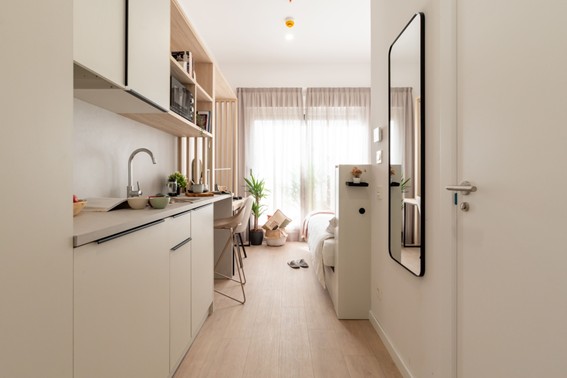
At Canvas, all the rooms are fully furnished and designed for studying, resting and having your things organised from the first day. On our website you can filter by room type and see real photos.
3. Services included: what's included in the fee (and what's not)
A key point when choosing a student hall of residence is to know what exactly is included in the monthly price. Not all halls of residence operate in the same way.
Check if the fee includes:
- Utilities: water, electricity, heating and air conditioning.
- WiFi throughout the building.
- Cleaning of rooms and common areas (and how often).
- Change of sheets and towels.
- Maintenance (repairs in rooms and common areas).
- 24-hour security or reception staff.
- Parcel management (very useful if you shop online).
- Gym and/or sports facilities.
- Study areas and rooms for group work.
- Events and activities for residents.
The more services included, the easier it’ll be to control your monthly budget and the less you’ll have to contract or manage on your own.
The Canvas model is 'all-inclusive': utilities, WiFi, maintenance, 24/7 security, regular cleaning, linen/towel changes (depending on hall of residence), parcel management, common spaces and student community.
4. Environment and community: what it’s like to live in at hall of residence
When choosing a student hall of residence, you don't just choose a building; you choose a social environment:
- Does it organise events and activities (parties, tournaments, workshops, cinema, etc.)?
- Are there spaces designed for socialising (common rooms, terraces, social club)?
- What profile of students live there? (national, international, mix of undergraduate and postgraduate, etc.).
If you find it hard to make friends or are going to a new city, living in a hall of residence with an active community can make a big difference. You’ll have:
- People to study with at exam time.
- Impromptu plans without leaving the building.
- Contacts from day one.
Canvas halls of residence often have a calendar of activities: themed parties, film nights, tournaments, sporting events, Christmas gatherings, etc.
5. Real budget: beyond the room rate
To compare correctly, don't just look at the price of the room. Calculate the total monthly cost:
- Hall of residence fee.
- Transport (if you’re far from campus).
- Lunch.
- Leisure and sport (gym, classes, etc.).
When choosing a student hall of residence, bear in mind that:
-
One with a seemingly higher price can be the same or even cheaper if it includes:
- Utilities
- WiFi
- Gym
- Cleaning
- Reduced transport due to location
-
A cheap shared flat can be made more expensive because of:
- Electricity and gas increases
- Intensive use of air conditioning/heating
- Daily transport to campus
Make a comparative table:
- Hall A
- Hall B
- Shared flat
And for each one, write down: accommodation + utilities + transport + fixed extras. You’ll be surprised how the differences change when you look at the whole picture.
.png)
6. Contract and cancellation policy: small print that matters
Before making a final decision when choosing a student hall of residence, check:
-
Duration of the contract
- Full course, term, short stays.
-
Deposit or booking fee
- How much it is, when it is paid and under what conditions it is returned.
-
Cancellation policy
- What happens if you’re not accepted to the university?
- What happens if you have to leave early?
It’s important to be clear on:
- Penalty-free cancellation periods (if any).
- Room/time of stay change options.
7. Extra services and details that make the difference
When comparing halls of residence, also look at little details that, when added together, have a big impact on your day-to-day life:
- Laundry in the building (self-service or managed).
- Outdoor areas (courtyards, terraces, gardens).
- Quiet vs more social spaces (you may be interested in both).
- Accessibility if you have specific needs.
- Attention at reception and support (opening hours, languages, speed of response).
At many Canvas halls of residence you’ll find:
- Laundry inside the building.
- Outdoor areas to disconnect.
- The reception team knows the city well and can help you with day-to-day questions (doctor, registration, transport, etc.).

8. How to use this guide to choose your hall of residence
To apply this comprehensive guide to choosing a student hall of residence, you can follow these steps:
- Make a short list of halls of residence in your target city (for example: 2-3 halls + the option of a shared flat).
-
Create a comparison table with these columns:
- Location and time to campus
- Type of room
- Services included
- Community and activities
- Approximate monthly price (total cost)
- Contract and cancellation conditions
-
Assess what holds more weight for you:
- Proximity to campus?
- All-inclusive and no hassles?
- Social environment and international community?
-
Contact the halls of residence to resolve any doubts:
- Ask about availability, in-person or virtual tours, and contract details.
If you’re looking for a hall of residence with an all-inclusive model, an international atmosphere and a good location in cities such as Pamplona, Seville or Sabadell, you can contact us.